Insights
•
AI-Powered Marketing: The Future of Digital Marketing in 2026
## Introduction
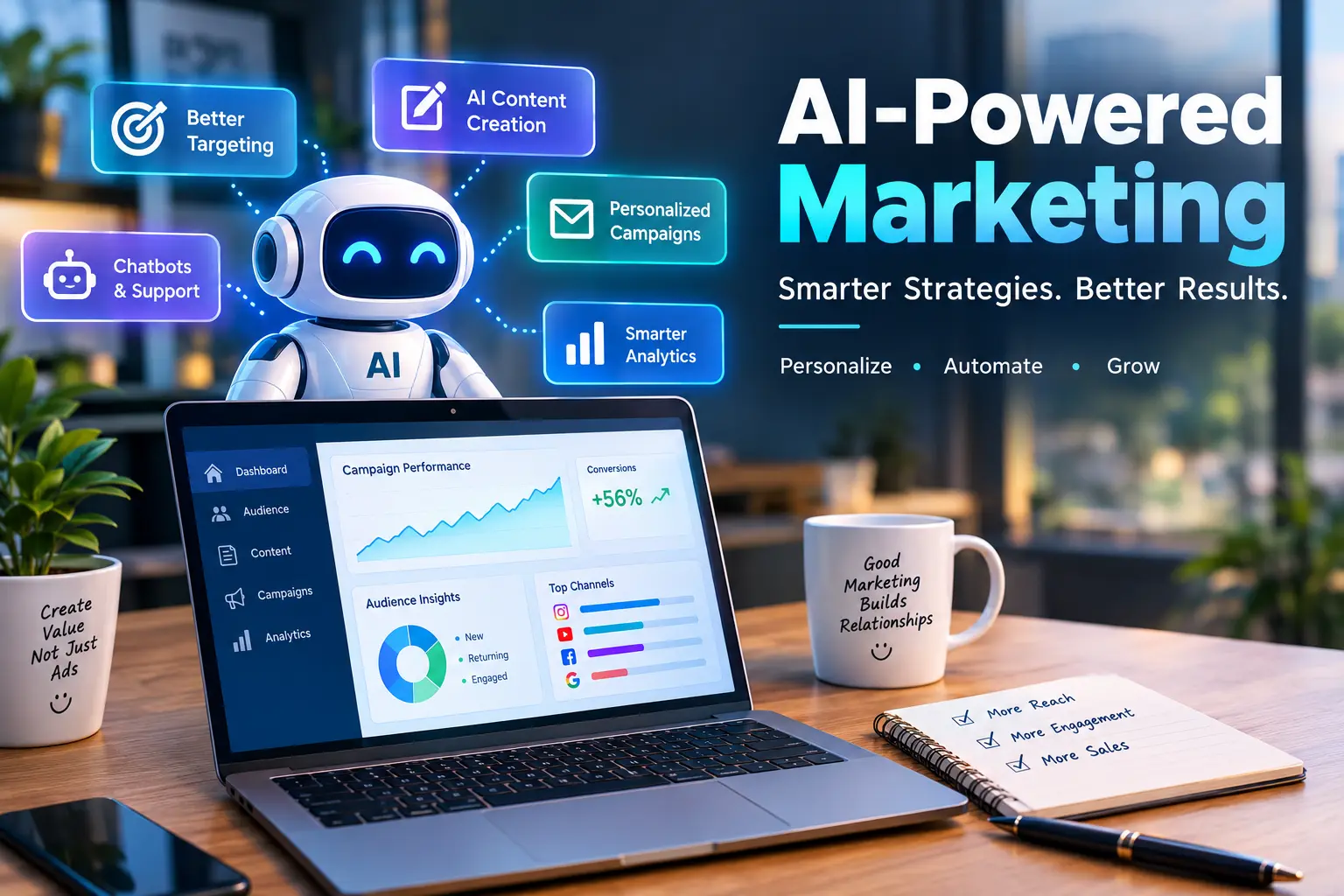
Artificial Intelligence (AI) is transforming the way businesses connect with customers, promote products, and grow online. In today's digital world, companies are using AI-powered marketing tools to understand customer behavior, create personalized experiences, automate repetitive tasks, and improve marketing performance.
AI-powered marketing is no longer just a future concept. It is becoming an important part of modern digital marketing strategies. From personalized emails to AI-generated content and intelligent chatbots, businesses of all sizes can use AI to make their marketing more efficient.
## What Is AI-Powered Marketing?
AI-powered marketing is the use of artificial intelligence technologies to plan, execute, and improve marketing activities. These technologies can analyze large amounts of data, identify patterns, predict customer preferences, and assist marketers in making better decisions.
For example, an online store can use AI to recommend products based on a customer's interests. Similarly, a business can use an AI chatbot to answer frequently asked questions and help customers find information quickly.
The main goal of AI-powered marketing is to deliver more relevant experiences while saving time and improving business results.
## Top Benefits of AI-Powered Marketing
### 1. Personalized Customer Experiences
One of the biggest advantages of AI marketing is personalization. AI tools can help businesses understand customer interests and preferences, allowing them to provide more relevant recommendations, offers, and content.
For example, an online shopping website may recommend products related to a customer's previous purchases or browsing activity, subject to appropriate data permissions.
### 2. Faster Content Creation
Creating high-quality marketing content takes time. AI tools can assist marketers with blog outlines, social media captions, email drafts, advertising ideas, and video scripts.
However, AI-generated content should always be reviewed, edited, and fact-checked to ensure that it is accurate, original, and useful to readers.
### 3. Better Customer Support With AI Chatbots
AI chatbots can help businesses respond to common customer questions around the clock. They can provide product information, explain services, and guide customers through basic processes.
When a question requires human judgment or personal assistance, the chatbot should be able to direct the customer to a human representative.
### 4. Smarter Advertising Campaigns
AI can help marketers analyze advertising performance, identify promising audience segments, and test different versions of advertisements.
These insights can help businesses improve campaign performance and use their advertising budgets more effectively. Results still depend on campaign quality, audience selection, and the product or service being promoted.
### 5. Data-Driven Decision-Making
AI-powered analytics can help businesses identify patterns in website traffic, customer engagement, sales, and advertising results.
Instead of relying only on assumptions, marketers can use these insights to understand what is working and decide what to improve.
## Popular AI Tools for Digital Marketing
Several tools can help marketers with different tasks:
- **ChatGPT:** Brainstorming, research assistance, blog outlines, and marketing copy.
- **Google Gemini:** Research assistance, idea generation, and content planning.
- **Canva AI:** Visual design assistance and marketing creatives.
- **HubSpot:** Marketing automation, customer relationship management, and AI-assisted workflows.
- **Google Analytics:** Website traffic analysis and campaign measurement.
Each tool serves a different purpose, so businesses should select tools according to their needs, budget, and workflow.
## How Businesses Can Use AI-Powered Marketing
Businesses can start using AI marketing through a few practical steps:
1. **Set a clear goal:** Decide whether the objective is to increase website traffic, generate leads, improve customer support, or increase sales.
2. **Choose the right tools:** Select AI tools that solve a specific marketing problem.
3. **Understand your audience:** Use appropriate customer insights to create relevant messages.
4. **Create and review content:** Use AI for assistance, then add human expertise, originality, and brand personality.
5. **Measure performance:** Track metrics such as engagement, conversion rate, qualified leads, and return on advertising spend.
6. **Improve continuously:** Use the results to refine campaigns and customer experiences.
Starting with one simple use case is often more practical than automating every marketing activity at once.
## Challenges of AI-Powered Marketing
Although AI offers many benefits, it also comes with challenges.
**Data privacy:** Businesses must handle customer information responsibly and follow applicable privacy laws.
**Accuracy:** AI tools can produce incorrect or misleading information, so important claims need verification.
**Lack of originality:** Depending too heavily on automated content can make a brand sound generic.
**Human creativity:** AI can assist with ideas and analysis, but understanding emotions, culture, and customer relationships still requires human judgment.
**Cost and learning:** Some advanced tools require paid subscriptions, training, and time to integrate into existing workflows.
The best approach is to combine AI efficiency with human creativity, critical thinking, and ethical practices.
## The Future of AI-Powered Marketing
The future of AI marketing is likely to involve more advanced personalization, conversational shopping experiences, predictive analytics, and automated campaign optimization.
AI tools will continue to help marketers work with data and produce content more efficiently. At the same time, trustworthy information, transparency, privacy, and authentic communication will remain important.
Businesses that learn to use AI responsibly and strategically may be better positioned to adapt to changing customer expectations and digital marketing technologies.
## Conclusion
AI-powered marketing is changing how businesses attract customers, create content, analyze performance, and build relationships. It offers opportunities to save time, improve personalization, and make more informed marketing decisions.
However, success does not come from using AI alone. Businesses need clear goals, reliable data, quality content, human oversight, and continuous improvement.
**The key to successful AI-powered marketing is simple: use artificial intelligence to work smarter while keeping human creativity and customer trust at the center of every strategy.**
Want to scale your business organic traffic?
Let WebBrandBuilders optimize your search appearance & design strategies.